

In the rapidly evolving digital content landscape, AI-generated content has become a cornerstone of efficiency and scalability. From simple product descriptions to complex news articles, AI's role in content creation is undeniable. However, the real challenge emerges when this AI-generated content needs a human touch to resonate with its audience. This introduction explores the intersection of AI efficiency and human authenticity, highlighting the essential role of humanizing AI-generated content for genuine engagement.
While AI content generators, powered by machine learning and natural language processing, offer significant productivity boosts, they often fall short in capturing the nuances of human communication. This gap not only raises concerns about the originality and contextual relevance of AI-generated content but also about its ability to connect with readers on an emotional level. Our journey in this blog is to demystify the process of humanizing AI text and to introduce WriteHuman, an innovative solution designed to bridge this gap, ensuring that AI content not only informs but also engages and relates to its audience.
Join us as we delve into the world of AI content humanization, where technology meets the art of storytelling, and discover how to transform AI-generated text into content that breathes authenticity and human warmth.
Table of Contents
The Evolution of AI in Content Creation
The journey of AI in content creation has been nothing short of revolutionary. Initially focusing on generating simple, factual content like weather reports or stock updates, AI has now advanced to producing complex and nuanced writing. This evolution from basic text generation to crafting sophisticated narratives mirrors the increasing adaptability of AI in mimicking human writing styles, a leap that has changed the face of content creation across industries.
The core technologies driving this transformation are Machine Learning (ML) and Natural Language Processing (NLP). ML algorithms enable AI systems to learn and refine their writing skills continually, while NLP allows these systems to understand and interpret human language, even capturing the subtleties of sentiment and context. This combination enables AI to produce content that ranges from persuasive to informative, adapting to the specific needs of different projects and industries.
The benefits of using AI in content creation are manifold. AI brings unparalleled efficiency and speed to the table, significantly reducing production times and allowing for rapid content generation. This efficiency is coupled with a consistent and accurate writing style, ensuring that the output maintains the quality and reliability essential for professions like journalism or scientific writing. Furthermore, AI's ability to analyze vast amounts of data and extract relevant insights paves the way for content that remains fresh, relevant, and engaging.
Perhaps one of the most notable advancements is AI's capability to personalize content. By analyzing user data and preferences, AI can tailor its output to specific audiences, creating a more intimate and engaging experience for readers. This level of personalization, along with the scalability offered by AI tools, ensures that content not only reaches but also resonates with a wider audience, amplifying its impact across various platforms and languages.
The Art of Humanizing AI-Generated Text
As AI continues to enhance content creation, balancing its technical prowess with the human touch becomes crucial. AI-generated content, while efficient and accessible, often lacks the emotional depth and creativity inherent in human writing. This absence is felt in the content's ability to resonate with audiences, demonstrate empathy, and offer original perspectives.
Humanizing AI content involves infusing it with elements that AI alone cannot replicate. Humans possess the unique ability to empathize, innovate, and connect on a personal level. By integrating human creativity, we can transform AI-generated text into narratives rich with personal viewpoints, emotional resonance, and relatability.
Moreover, personalization is key. AI might excel in generating content quickly, but human writers bring the personal touch, tailoring content to specific audiences and adding emotional layers that engage readers deeply. This blend of AI efficiency and human creativity is essential for creating compelling, memorable, and emotionally impactful content that forms lasting connections with the audience.
Why Human Touch Matters in AI Content
The rise of AI in content creation marks a significant shift in digital marketing and other industries. While AI's advancements have made content more human-like and reliable, the human touch remains irreplaceable for several critical reasons. AI-generated content, despite its efficiency, often lacks creativity, originality, and the subtle nuances that only human experiences can provide. It struggles with contextual understanding, especially in terms of cultural nuances and social references, leading to content that may seem disconnected or irrelevant to specific audiences.
Creativity and originality are at the heart of compelling content. Humans can inject personality, voice, and new ideas into their writing, elements that AI, bound by its programming and data, cannot replicate. This unique human contribution ensures that content is not just informative but also engaging, with a distinct style that resonates with readers on a deeper level.
Moreover, ethical concerns and biases in AI content highlight the importance of human oversight. AI systems, despite being neutral, can unknowingly perpetuate biases present in their training data. Human intervention is crucial in ensuring that content is not just accurate and unbiased but also ethically sound and culturally sensitive.
Ultimately, the human touch in writing is about more than just adding a personal flair; it's about creating content that truly connects with the audience. This connection is achieved through personalization, emotional depth, and a narrative voice that AI alone cannot offer. By combining AI's efficiency with human creativity and empathy, content creators can produce work that not only informs but also inspires and captivates.
Techniques to Humanize AI Content
In a world where AI-generated content is becoming increasingly prevalent, humanizing this content is crucial for creating a genuine connection with your audience. Here are some effective techniques to infuse AI-generated text with human qualities:
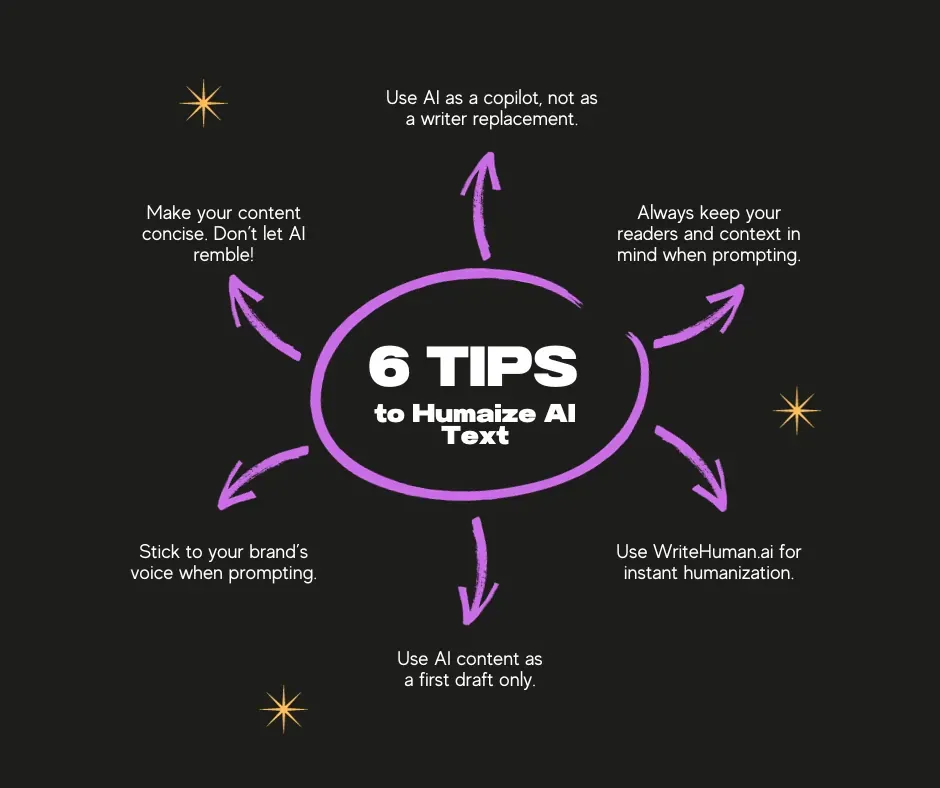
Humanize Your Strategy: It's essential to blend AI efficiency with human creativity and insight. Discuss with your team to include unique and advanced tips that resonate with your audience. Sometimes, a sensitive topic may require a delicate and humanized approach for better relatability.
Use AI Content as a First Draft: Consider AI-generated content as a starting point. This approach allows human writers to refine and enhance the content, adding personal touch and context. Publications like The Washington Post have utilized AI for initial drafts, which are then humanized by their writers.
Stick to Your Brand’s Voice: Maintaining your brand's unique voice in AI-generated content is vital. Whether it’s casual and friendly or formal and sophisticated, ensure the AI content aligns with your brand personality.
Consider Context: AI often lacks the ability to understand the specific context of the target audience. Answer questions like who your target readers are, why the content is relevant to them, and how you want to communicate with them. This ensures that the AI-generated content is tailored to your audience’s needs.
Make It Concise: AI-generated content can sometimes be verbose. Breaking up long paragraphs into shorter, more conversational pieces helps in making the content more human-like and relatable.
Use WriteHuman: Let us do the heavy lifting for you. With WriteHuman, you can offload the laborious tasks, allowing you to concentrate on what truly matters. Our specialized models are meticulously designed to infuse an authentic human touch into your content. Whether you're crafting blog posts, marketing materials, or any written work, WriteHuman not only refines grammar and structure but also captures your desired tone and style.
Challenges and Future of Humanizing AI Content
Humanizing AI content is not without its challenges. While AI has improved significantly, it still faces limitations in providing human touch and emotional connection. One major challenge is AI's inability to fully grasp complex emotions and cultural nuances. This leads to content that can feel detached and impersonal. Additionally, AI-generated content may contain biased or inaccurate information, as it relies on existing data that may be flawed.
Authenticity and emotional connection are crucial in overcoming these challenges. It's essential for AI to convey genuine emotions and establish deep connections with users. This can be achieved by using authentic language, incorporating user stories and testimonials, and responding empathetically to user emotions. Enhancing emotional connection and engagement is key to making AI content more human-like and relatable.
Looking towards the future, ethical considerations play a significant role in the humanization of AI content. Companies must strike a balance between human-like interactions and ethical boundaries to build trust and ensure user satisfaction. Ethical guidelines and regulatory frameworks are needed to guide the use of AI content, addressing potential biases, privacy concerns, and other ethical challenges.
Conclusion
The evolution of AI in content creation has brought about remarkable efficiency and scalability. However, the human touch remains essential to make this content resonate with audiences. By incorporating human creativity, empathy, and personal experiences, we can transform AI-generated text into engaging, authentic, and emotionally rich narratives. Tools like WriteHuman play a pivotal role in this process, bridging the gap between AI efficiency and human authenticity.
Frequently Asked Questions
How to Humanize AI Text?
Humanizing AI text involves adding personal touches, emotional depth, and unique viewpoints to AI-generated content. Techniques include using conversational language, incorporating personal stories, adjusting content to fit your brand's voice, and ensuring the content resonates emotionally with the audience.
Can Humans Recognize ChatGPT's AI-Generated Text?
While AI-generated text from tools like ChatGPT has become increasingly sophisticated, humans can often recognize it due to its lack of personal nuances, emotional depth, and sometimes, contextual errors. Incorporating a human touch can help in making the content more relatable and less detectable as AI-generated.
How to Humanize AI-Generated Text for Better Engagement?
To humanize AI-generated text for better engagement, focus on adding elements of human creativity such as humor, personal anecdotes, and a conversational tone. Personalization to the target audience and maintaining the brand voice are also key factors in enhancing engagement.
How to Humanize AI-Written Text?
Humanizing AI-written text involves infusing it with elements of human creativity, such as personal experiences, empathy, and a unique narrative voice. Adjusting the tone to be more conversational and ensuring the content aligns with human emotions and experiences can significantly enhance its appeal.