
How Free Undetectable AI is Transforming the Writing Landscape
Introduction
Few innovations have sparked as much intrigue and potential for disruption as Artificial Intelligence (AI). Once a subject of science fiction, AI has rapidly become an inextricable part of our daily lives. However, the recent emergence of free undetectable AI marks a new chapter in this ongoing saga, one where the boundaries of possibility are continuously being redrawn.
This blog post delves into the burgeoning world of free undetectable AI, a realm where advanced AI tools are not only widely accessible but also operate with a level of sophistication that makes their presence virtually imperceptible. In this landscape, the lines between human and machine intelligence are increasingly blurred, creating a tapestry of opportunities and challenges that are reshaping the tech industry in profound ways.
Through this exploration, we aim to unravel the complex fabric of free undetectable AI, examining its implications across various sectors. From transforming business operations to redefining cybersecurity landscapes, and stirring ethical debates, this technology is not just a tool in the hands of the few but a phenomenon that is redefining the contours of our technological future. The journey through this transformative landscape promises insights into a future where AI is not just a part of technology but becomes a seamless aspect of our everyday experience.
In the following sections, we will journey through the essence of free undetectable AI, its multifaceted impacts, the challenges it presents, and the future it is unearthing. This exploration is not just an academic exercise but a voyage into the heart of a technological revolution that is quietly, yet decisively, transforming the world as we know it.
What is Free Undetectable AI?
Definition and Characteristics of Free Undetectable AI
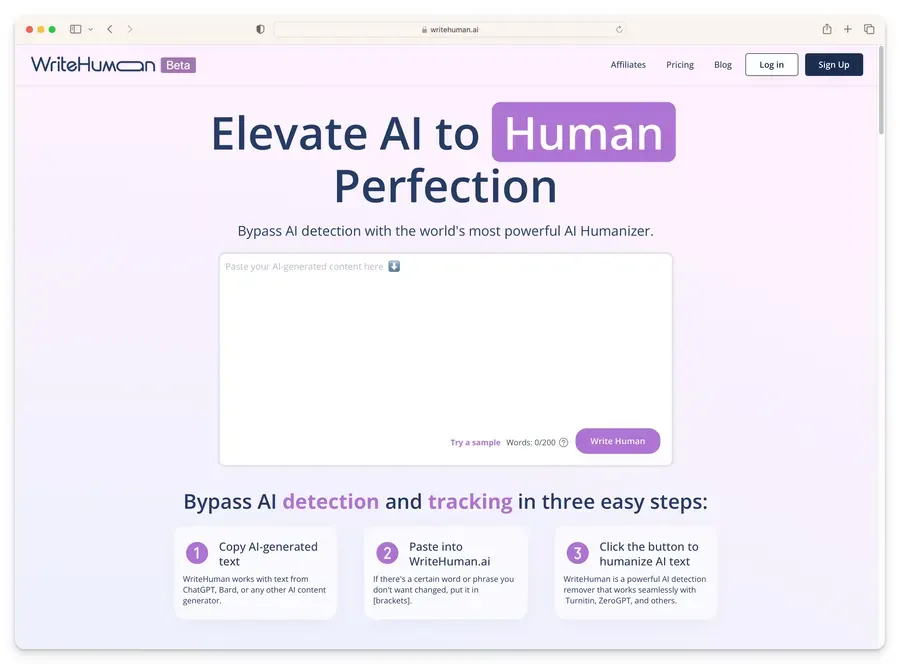
Free undetectable AI refers to advanced artificial intelligence systems that are readily accessible to the public at no cost and operate with such finesse that their functioning is virtually indistinguishable from human actions. These systems embody a level of sophistication where their analyses, decisions, and creations seamlessly blend into human contexts, making their artificial nature imperceptible. There are tools on the market that create undetectable AI, such as WriteHuman.
Historical Context and Recent Advancements
The genesis of AI can be traced back to the mid-20th century, with early concepts and experiments that laid the groundwork for what we see today. However, it was the advent of machine learning and, subsequently, deep learning in the 21st century that catapulted AI into a new era of innovation. These technologies enabled AI to analyze vast datasets, learn from them, and make decisions with minimal human intervention.
Recent advancements in AI have been driven by significant improvements in computational power, algorithmic sophistication, and data availability. The development of neural networks mimicking human brain functions, the rise of natural language processing, and the refinement of predictive analytics are some of the milestones that have marked this journey. Today's AI systems are capable of tasks ranging from creating art to diagnosing diseases, often with a level of proficiency comparable to or surpassing human experts.
The "Free" Aspect: Accessibility and Open-Source Platforms
One of the most pivotal aspects of contemporary AI development is its transition from being a resource-intensive technology limited to well-funded organizations, to becoming widely accessible through free, open-source platforms. This democratization of AI has been facilitated by several factors:
Open-Source Software: Platforms like TensorFlow, PyTorch, and others offer powerful AI tools that anyone with internet access can use. These platforms are not just free but are also constantly improved by a global community of developers.
Cloud Computing: The rise of cloud computing has allowed individuals and small enterprises to access high-powered computing resources on-demand, often for free or at minimal cost. This has significantly lowered the barrier to AI development and experimentation.
Community and Collaboration: There is a growing global community dedicated to open AI research and development. This community ethos not only promotes the sharing of resources but also fosters an environment of collaborative learning and innovation.
Moreover, an exemplary embodiment of this democratization and innovation in AI is vividly illustrated by platforms like WriteHuman. Operating at the forefront of the free undetectable AI wave, WriteHuman offers a unique blend of freemium services that encapsulate the ethos of accessible, advanced AI technology.
WriteHuman: Pioneering in Free Undetectable AI
WriteHuman stands out as a beacon in the AI landscape, providing users with sophisticated AI tools tailored for a range of applications. What sets WriteHuman apart is its commitment to offering core services for free, embodying the true spirit of democratizing AI technology. This approach ensures that individuals and small businesses can leverage the power of advanced AI without the barrier of cost.
The platform's freemium model is a testament to the potential of free undetectable AI in fostering innovation and creativity across various sectors. Users can access basic AI services without any charge, while also having the option to upgrade to more advanced features as their needs evolve. This flexibility makes WriteHuman not just a tool but a partner in growth and innovation for its users.
In an era where accessibility to technology is pivotal for leveling the playing field, WriteHuman exemplifies how free undetectable AI can be a catalyst for change and progress. By offering cutting-edge AI capabilities in an accessible format, WriteHuman is not just a platform; it's a harbinger of a future where technology empowers and elevates every individual and enterprise, irrespective of their size or resources.
Undetectable AI: Key Areas of Impact
Business and Industry
Customer Support: AI has revolutionized customer support by enabling businesses to provide 24/7 service through intelligent chatbots and virtual assistants. These AI-driven systems can handle a wide range of customer queries with remarkable accuracy and efficiency, significantly reducing wait times and improving customer satisfaction. Furthermore, they can learn from customer interactions, continuously improving their responses and the overall customer experience.
Marketing and Communication: In the realm of marketing, AI is a game-changer. It can analyze vast amounts of data to identify trends and insights, helping businesses tailor their marketing strategies to specific audiences. AI-driven tools are capable of personalizing customer interactions, predicting consumer behavior, and optimizing marketing campaigns in real-time, leading to higher engagement and conversion rates.
Undetectable AI in the Writing Industry
The impact of AI in writing, particularly in the context of Search Engine Optimization (SEO), is profound. AI tools can assist in generating content that is not only engaging and informative but also optimized for search engines. This is particularly beneficial for those with English as a second language, as AI can help overcome language barriers, ensuring content is both linguistically accurate and culturally relevant.
Moreover, AI-driven writing aids can suggest keywords, analyze the effectiveness of content, and even predict how well a piece of writing will perform in search engine rankings. This capacity to enhance both the quality and reach of written content is invaluable in the digital age, where visibility and engagement are paramount.
Ethical and Privacy Considerations
As free undetectable AI becomes more integrated into our daily lives, ethical and privacy considerations become increasingly important. In the context of non-native English speakers, AI tools should be used responsibly, ensuring they respect cultural nuances and ethical boundaries. This includes being vigilant about biases in AI algorithms and safeguarding user data privacy.
AI writing tools should be designed to enhance human capabilities, not replace them. They should serve as aids that empower users, especially those facing language barriers, to express themselves more effectively while maintaining their unique voice and perspective.
Furthermore, there must be transparency in how these AI systems operate and use data. Users should be informed about what data is collected, how it is used, and the measures taken to protect their privacy. This transparency is crucial in building trust and ensuring that the use of AI remains ethical and responsible.
In conclusion, the impact of free undetectable AI across these areas highlights its potential to be a powerful tool for innovation and progress. However, it also underscores the need for careful consideration of ethical and privacy implications to ensure that its benefits are realized responsibly and equitably.
Challenges and Considerations of Free Undetectable AI
Challenges and Controversies
The ascent of free undetectable AI, while laden with opportunities, is not without its challenges and controversies. As we embrace this transformative technology, it's imperative to confront and address its potential downsides and ethical dilemmas.
Job Displacement
One of the most pressing concerns is job displacement. As AI systems become more capable of performing tasks traditionally done by humans, from customer service to content creation, the fear of widespread unemployment looms large. While AI can increase efficiency and reduce costs, the potential loss of jobs creates a need for societal adaptation. This includes rethinking job roles, investing in human-AI collaboration, and emphasizing the importance of skills that AI cannot replicate, such as creativity, empathy, and complex problem-solving.
Bias in AI
Another significant issue is the inherent bias in AI systems. AI algorithms are only as unbiased as the data they are trained on and the designers who create them. There have been instances where AI systems have shown racial, gender, or socioeconomic biases, leading to unfair and discriminatory outcomes. This raises serious concerns about the reliability and fairness of AI decisions, especially in critical areas like hiring, law enforcement, and healthcare.
Global Disparities in Access and Impact
The benefits and impacts of AI are not distributed equally across the globe. There are stark disparities in access to AI technology, with developed countries and large corporations having the lion's share of resources and expertise. This digital divide exacerbates existing inequalities and could lead to a future where the benefits of AI are enjoyed by a few while the majority are left behind. Bridging this gap requires concerted efforts to make AI technology more accessible and to build capacities in underrepresented regions and communities.
The Debate Over AI Governance and Ethical Frameworks
The rapid evolution of AI has outpaced the development of governance structures and ethical frameworks to regulate its use. This leads to a crucial debate on how to govern AI effectively, ensuring that it is used for the greater good while safeguarding individual rights and societal values. Questions arise about who should be responsible for regulating AI, how to ensure transparency and accountability, and what ethical principles should guide AI development and deployment.
Conclusion
The journey through the landscape of free undetectable AI reveals a technological revolution with the power to reshape every facet of our society. This AI, characterized by its accessibility, sophistication, and seamless integration into our daily lives, is not just a technological advancement but a catalyst for profound transformation. From revolutionizing business and industry to democratizing access for non-native English speakers and sparking debates on ethics and privacy, its impact is far-reaching.
However, as we stand at this crossroads of innovation and responsibility, it becomes clear that the path forward requires a delicate balance. The transformative power of AI must be harnessed with a conscientious approach, considering the potential repercussions on employment, societal structures, and ethical norms. This balance is not just desirable but necessary to ensure that the benefits of AI are equitably distributed and its risks are mitigated.
As we contemplate the future shaped by AI, the call to action is twofold. First, there is a need for ongoing dialogue and collaboration among technologists, policymakers, ethicists, and the public to guide the ethical development and deployment of AI. Secondly, individuals and organizations must proactively adapt to this changing landscape, embracing lifelong learning and innovation to remain relevant and resilient in an AI-driven future.
In this context, platforms like WriteHuman emerge as exemplary models, embodying the best of what free undetectable AI has to offer. WriteHuman stands out as a tool that not only provides sophisticated AI capabilities but also champions the principles of accessibility, ethical usage, and continuous innovation. It serves as a beacon for how AI can be leveraged responsibly and effectively, making it an invaluable asset for anyone looking to harness the power of AI.
As we venture further into this AI-augmented era, let us embrace the possibilities with optimism, caution, and a commitment to using these powerful tools, like WriteHuman, to create a future that is not only technologically advanced but also socially responsible and inclusive. The future of AI is not just about what the technology can do; it's about what we choose to do with it.
FAQs
How to Make AI Text Undetectable
Q1: What does it mean to make AI-generated text undetectable?
Making AI-generated text undetectable means ensuring that the text appears as if it were written by a human, without obvious signs that it was generated by an AI program. This involves mimicking natural language patterns, nuances, and variations that are typically found in human writing.
Q2: What techniques can be used to make AI text more human-like?
Techniques include using varied sentence structures, incorporating idiomatic expressions, avoiding repetitive phrases, and ensuring contextually relevant content. Additionally, employing advanced AI models that have been trained on diverse datasets can improve the human-likeness of the text.
Q3: Can AI-generated text be completely undetectable?
While advanced AI can produce highly convincing text, there's always a possibility of detection, especially with the development of sophisticated AI detection tools. The goal is to minimize detectability as much as possible.
Applications of Free Undetectable AI
Q1: What are some common applications of free undetectable AI?
Applications include content creation, customer service automation, personalized marketing, language translation, and educational tools. These applications leverage AI's ability to process and generate human-like text or interactions.
Q2: How is free undetectable AI used in healthcare?
In healthcare, such AI can assist in patient communication, medical documentation, and even in creating personalized health plans based on patient data analysis.
Q3: Can free undetectable AI be used in creative industries?
Yes, it's used in creative writing, scriptwriting, and content generation for blogs, articles, and advertising, offering new avenues for creativity and efficiency.
Ethical Considerations Surrounding Free Undetectable AI
Q1: What are the primary ethical concerns with free undetectable AI?
Concerns include the potential for misuse in spreading misinformation, the amplification of biases present in training data, privacy issues related to data collection, and the lack of transparency in AI decision-making processes.
Q2: How can the ethical use of free undetectable AI be ensured?
Ethical use can be promoted through transparent AI development practices, regular audits for bias, strict privacy policies, and guidelines for responsible usage by users.
Q3: Is there a risk of AI replacing human jobs?
There is a risk in certain sectors, but AI also creates opportunities for new job roles and can augment human capabilities in many fields, rather than replace them.
Free Undetectable AI in the Writing Landscape
Q1: How is free undetectable AI transforming writing?
It's enabling faster content generation, aiding in language translation, providing tools for grammar and style improvement, and offering creative suggestions, thereby enhancing both the efficiency and quality of writing.
Q2: Can AI tools help non-native English speakers in writing?
Yes, AI writing tools can significantly assist non-native speakers by suggesting correct grammar, appropriate vocabulary, and stylistic improvements, making their writing more fluent and natural.
Q3: Will AI replace human writers?
While AI can assist in many aspects of writing, it's unlikely to replace human writers entirely. The creative and empathetic aspects of human writing are still beyond the full scope of AI capabilities.